
Call Us Today
Call Us Today
We won a verdict for a single plaintiff in an action against a multi-national pharmaceutical company.
We won a jury verdict for a client who suffered head trauma and permanent scarring in an ATV rollover case in South Texas.
Won a settlement against a Fortune 500 pipeline company for burn victims of a plant explosion in South Texas.
Won settlement for family who lost loved one in trucking crash.
1B+ Recovered | 400+ Jury Trials | 30+ Years of Experience | 99% Success Rate
Across the country, survivors of sexual abuse within the Church of Jesus Christ of Latter-day Saints (LDS), often called the Mormon Church, are stepping forward to demand accountability. Filing a Mormon Church sexual abuse lawsuit is not only about seeking compensation for devastating harm—it is about exposing failures, protecting future generations, and ensuring survivors’ voices are heard. These are individual civil actions, and while courts may later consider coordinating similar cases for efficiency, each survivor’s claim stands on its own. The larger movement reminds survivors they are not alone—others are pursuing justice in parallel, and their voices matter.
At Kherkher Garcia LLP, our team has over 30 years of experience guiding survivors through some of the most difficult chapters of their lives. From our offices in Houston, we stand with individuals and families across Texas and nationwide, offering compassionate counsel, relentless advocacy, and the assurance that you do not have to face this fight alone.
A Mormon Church sexual abuse lawsuit is a civil action filed by survivors of sexual abuse within the Church of Jesus Christ of Latter-day Saints (LDS). These lawsuits are typically brought by individuals who were harmed as children, teens, or even as adults by clergy members, youth leaders, or trusted church volunteers. Families may also file claims on behalf of loved ones who were abused. At their core, these lawsuits allege that church leadership failed to protect members, ignored or concealed reports, or created an environment where predators could act unchecked.
These claims are important today because cultural movements, new legislation, and expanded statutes of limitations now allow many survivors to seek justice after years of silence. Beyond financial compensation, these cases aim to expose institutional failures, provide accountability, and help protect future generations from the same harm.














Deciding to file a Mormon Church sexual abuse lawsuit is one of the most important steps a survivor can take toward justice. Choosing the right legal team can make all the difference. At Kherkher Garcia LLP, we bring more than 30 years of experience to the table, offering both legal knowledge and compassion for those who have endured abuse. We understand the sensitive nature of sexual abuse cases and guide survivors through each stage of the process with care and respect.
Client Reviews


Outstanding law firm—the staff graciously took care of me from start to finish. I was intimidated by the legal process in general, but after meeting with Kherkher Garcia, that fear went right out the window. My attorneys explained each step of the process and remained helpful through it all. I never doubted that my case was in the best hands!! Thank you Kherkher Garcia!
Steve Kherkher was a pleasure to work with. He took care of every little detail of our case from start to finish. His staff were wonderful also. This law firm goes above and beyond to help their clients. I would 100% recommend them to anyone I know. Thank you Steve for caring about our family and making sure our grandson was taken care of after his dad’s wrongful death. I cannot say thank you enough!
My experience with Kherkher & Garcia has been great. The attorneys are highly skilled and professional. The communication has been excellent. They are results oriented and they take care of their clients.
Couldn’t have chosen a better law firm ! Steve will fight tooth and nail to make sure you get what you deserve . They kept me informed throughout the whole process, and made sure to explain everything in detail. Nice , caring , and honest people ! 10 / 10 would recommend !!
Jesus Garcia is one of the best trial lawyers I have seen in action. He commands the attention of the jury when he speaks. He is a down to earth person and that is probably why he gets amazing results. He is professional and will treat you with respect. If you ever need a personal injury lawyer, I highly recommend that you call Jesus Garcia.
It is difficult to share some of the most tragic details you will ever experience with someone you don’t know. The Kherkher Garcia law firm will make you feel like family. They are there for you every step of the way when you don’t know which direction to go. Honest and fair. You will be happy you chose them.
The attorney and staff was very polite, responsive, and hard working during this difficult process. They took the time to keep me up to date with any and all proceedings. Very knowledgeable and ethical practice and would highly recommend.
View More Reviews on Google Maps
What sets us apart:
At Kherkher Garcia LLP, pursuing legal action means more than filing a case. It means partnering with a trusted ally who is fiercely committed to uncovering the truth, achieving justice, and empowering survivors to reclaim their voices and their lives.

Church-based sexual abuse often involves misconduct by individuals in positions of trust—whether clergy, lay leaders, staff, or volunteers. Across the United States, survivors have come forward with lawsuits against the Church of Jesus Christ of Latter-day Saints (LDS), alleging that church officials failed to prevent or properly respond to sexual abuse within local congregations. These filings, many of which have been brought in state courts and later removed to federal courts, reflect a nationwide pattern of survivors seeking accountability and transparency from the institution. The following recent cases illustrate the breadth and seriousness of these claims:
These cases reveal that LDS sexual abuse allegations extend far beyond clergy misconduct—encompassing teachers, volunteers, and local leaders—and highlight the continuing need for institutional accountability within church structures.
Texas has witnessed a growing number of sexual abuse claims involving religious organizations, including the LDS Church. One recent case illustrates how these lawsuits are unfolding in the state. In 2024, a civil complaint was filed in a Texas district court against a former LDS bishop, identified by the pseudonym John Doe. Court filings alleged that Doe admitted to his local church leaders in Texas that he had committed dozens of acts of child sexual abuse. According to reports, church leaders then notified police, as required under both LDS policy and Texas law. While the alleged abuse took place in Alaska and Alabama, the case proceeded in Texas, where Doe had served as bishop multiple times.
FLOODLIT obtained a copy of the civil complaint and confirmed that the church and Doe reached a settlement with the victim in 2025. For individuals in Houston, Dallas, and across the state, pursuing a Mormon Church sexual abuse lawsuit can provide both accountability and compensation for the harm suffered.

Our trial lawyers will go the distance against corporations and insurance companies to win the maximum compensation in your case.
We stand ready to fight for you against the injustices caused by negligent actions throughout the state of Texas and across the Nation.
Although many allegations of sexual abuse within the LDS Church date back decades, survivors often only found legal avenues in recent years due to changes in reporting laws and extended statutes of limitations. Several notable examples include:
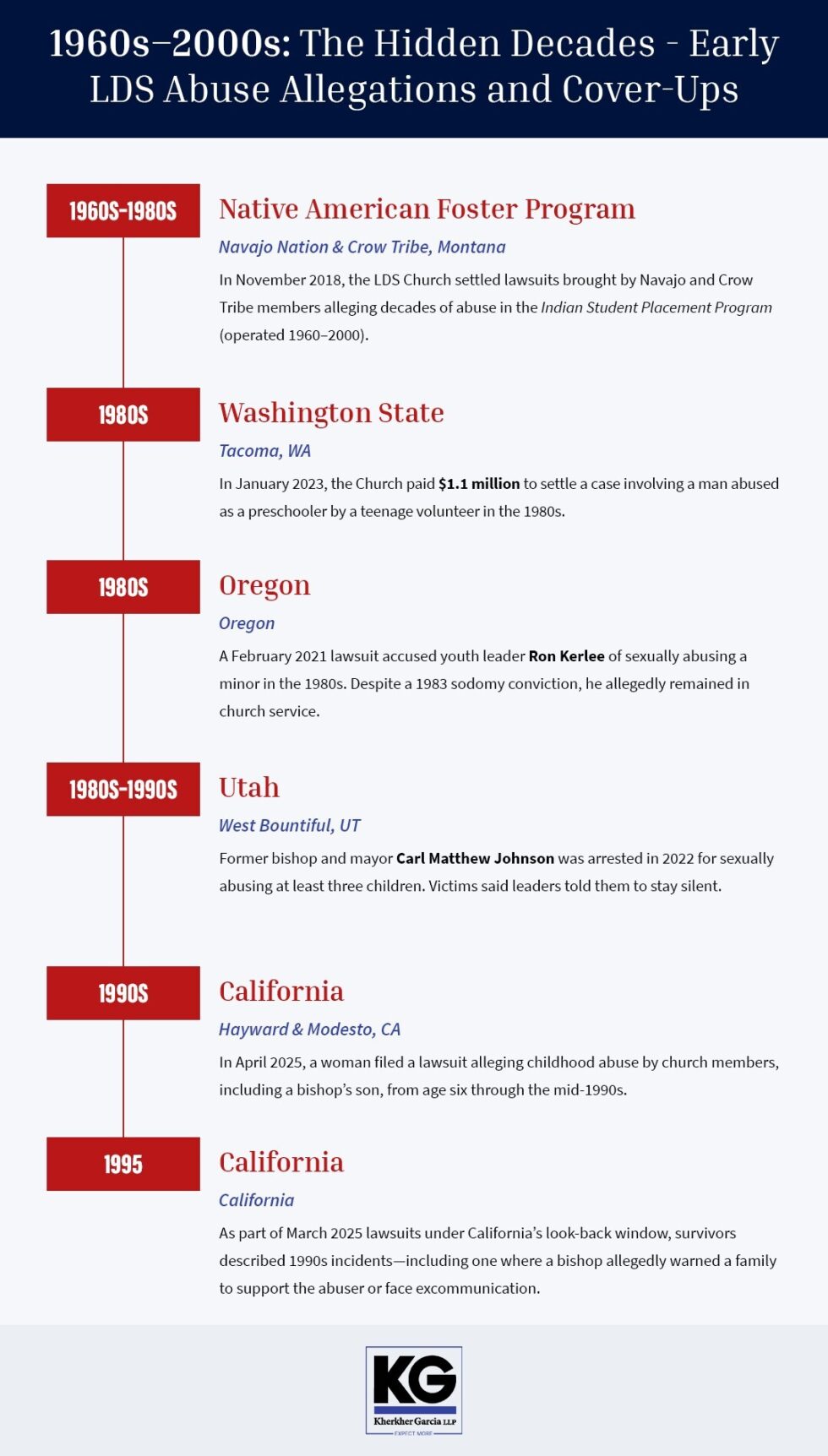
In recent years, survivors have filed a wave of lawsuits against the LDS Church, supported by shifting cultural movements and expanded legal rights. These cases expose decades of hidden abuse and highlight how institutional responses often failed to protect children and families:
Filing a Mormon Church sexual abuse lawsuit can feel overwhelming, but knowing the process helps survivors understand what to expect and where support is available. Every case is unique, yet the legal path usually follows several key steps designed to protect survivors’ rights and build the strongest case possible.
Each of these steps requires thoughtful preparation and survivor-centered advocacy. By working with Kherkher Garcia LLP, survivors gain not only legal representation but also a partner committed to ensuring their voice is heard, their evidence preserved, and their path to justice as strong as possible.

No Fees Unless We Win
Most LDS sexual abuse lawsuits involve children and teenagers, where predators targeted them through church programs and activities. Common patterns include:
Although less frequent, cases involving adults also reveal serious misconduct by LDS leaders. These differ in important ways:
A closely watched case in Arizona focuses on whether an LDS bishop was legally obligated to report a church member’s confession of child sexual abuse to authorities. The lawsuit, initially dismissed in 2023 under the state’s clergy-penitent privilege, was reinstated by the Arizona Court of Appeals in July 2025. The appellate court ruled that a jury should determine whether the circumstances required mandatory reporting under Arizona law. In public statements, the Church has maintained that its leaders followed existing state law and announced plans to appeal the decision.
Texas has seen multiple criminal convictions and civil lawsuits tied to LDS church members, underscoring the importance of holding the institution accountable. In 2019, Noel Anderson, a former LDS primary teacher in McKinney, Texas, was convicted of child molestation and sentenced to 50 years in prison. In San Antonio, Jared Anderson, once celebrated as a high school “teacher of the year” and Mormon youth leader, was sentenced to 10 years in prison for hosting sex parties with teenage boys. In the New Braunfels area, Emily Anderson, a Primary president within the Mormon Church, was convicted of sexually abusing children. FLOODLIT reports these cases.
These examples demonstrate that a Mormon Church sexual abuse lawsuit in Texas is not an isolated event but part of a broader pattern in which survivors argue the church ignored warnings about known abusers. By pursuing litigation, survivors are exposing long-standing failures to protect vulnerable members and demanding accountability in Texas courts and beyond.
Over the years, the LDS Church has faced intense criticism for how it handles sexual abuse claims. Survivors and advocates argue that reports were often managed internally rather than turned over to civil authorities, leaving predators free to harm additional victims. Numerous lawsuits allege that leaders minimized or concealed complaints to protect the church’s reputation instead of protecting children and vulnerable adults. These claims have led to multimillion-dollar settlements, ongoing litigation, and widespread media scrutiny.In response, the Church emphasizes that it maintains a strict zero-tolerance approach. According to the Church’s official newsroom: “The Church has a zero-tolerance policy when it comes to abuse. This means that if we learn of abuse, we cooperate with civil authorities to report and investigate the abuse. Offenders are also subject to the laws of God. Whether or not someone is convicted of abuse, offenders are subject to Church discipline and could lose their membership in the Church.”
This public stance contrasts sharply with the experiences described in many lawsuits, where survivors say the policy was not followed in practice, fueling the push for accountability through the courts.
Survivors of sexual abuse connected to the LDS Church may have the right to file a Mormon Church sexual abuse lawsuit in Texas. Claims can be filed directly by survivors, whether the abuse happened in childhood or adulthood, and in some cases, family members may also pursue action on behalf of loved ones who were harmed.
Under Texas law, survivors of childhood sexual abuse have up to 30 years from the date their cause of action accrues to file a civil lawsuit against any responsible party. This extended period, outlined in Tex. Civ. Prac. & Rem. Code §16.0045 applies to conduct such as sexual assault, aggravated sexual assault, and indecency with a child. However, the statute allows only limited exceptions for delayed discovery. For survivors in Houston, Dallas, and across the state, understanding these timelines is essential to protecting their rights and ensuring their claims are not barred by law.
No Fees Unless We Win
A mass tort is a legal process where many individuals file separate lawsuits involving similar facts against the same defendant, and the court consolidates these cases for efficiency. Unlike a class action—where one judgment applies to everyone—each survivor in a mass tort maintains their own lawsuit, with damages assessed individually.
This structure matters in LDS sexual abuse litigation because survivors often share common claims: church leaders failed to report, protected abusers, or concealed misconduct. By moving forward together, survivors benefit from:
For many, pursuing a Mormon Church sexual abuse lawsuit within a mass tort setting provides both solidarity and legal strength—ensuring that no case is overlooked and that survivors stand on equal footing with the church’s legal resources.
When pursuing a Mormon Church sexual abuse lawsuit, strong evidence is critical for demonstrating both the abuse itself and the institution’s knowledge or negligence. Courts recognize that many survivors were unable to come forward at the time, which means cases often rely on documentation that spans years or even decades.
Important forms of evidence can include:
Even when decades have passed, these pieces of evidence can be powerful. An experienced legal team knows how to locate and preserve institutional documents through subpoenas and discovery, ensuring that survivors are not left to shoulder the burden alone. By building a comprehensive evidentiary record, survivors maximize their ability to hold the LDS Church accountable and seek meaningful justice.
The effects of sexual abuse often extend far beyond the initial trauma. Survivors may struggle with mental health conditions such as depression, anxiety, or post-traumatic stress disorder (PTSD), sometimes lasting decades. Many report difficulty forming or maintaining relationships, mistrust of authority figures, and ongoing feelings of shame or isolation. Abuse can also disrupt education or career paths, creating long-term financial instability.
Families suffer too. Parents, spouses, and children may experience secondary trauma, fractured trust, and the emotional weight of supporting a loved one through recovery. In some cases, family members face additional medical or counseling costs as they cope with the consequences of abuse.
A Mormon Church sexual abuse lawsuit allows survivors to pursue compensation aimed at addressing both the financial and emotional toll of abuse. Depending on the circumstances, damages may include:
By pursuing compensation, survivors and their families achieve two critical outcomes: they secure essential resources needed for long-term healing and recovery, while simultaneously holding the LDS Church accountable for the institutional failures that allowed abuse to occur and persist unchecked.
Taking the step to file a Mormon Church sexual abuse lawsuit is not easy, but you do not have to face it alone. At Kherkher Garcia LLP, we provide a safe, confidential space where survivors can share their story and learn their legal options without pressure. Our team has decades of experience guiding clients through some of the most sensitive cases, always with dignity and compassion. Justice is possible, and every survivor deserves the chance to pursue it. Call us today at 713-333-1030 for a free and completely confidential consultation.
Steve Kherkher is passionate about serving his clients. He has dedicated his life to championing the rights of those who have experienced catastrophic injury due to negligence.
Steve Kherkher, along with Trial Lawyer Jesus Garcia, founded Kherkher Garcia, and under their leadership, the firm achieved unprecedented success within its first three years.
With a career spanning over 35 years, Steve’s tireless pursuit of justice for his clients has earned him national recognition and numerous accolades as an exemplary trial attorney.

This page has been written, edited, and reviewed by a team of legal writers following our comprehensive editorial guidelines. This page was approved by attorneys Steve Kherkher and Jesus Garcia Jr., who have more than 50 years of combined legal experience championing the rights of those who have experienced catastrophic injury due to negligence.
Connect with a Kherkher Garcia trial lawyer today to pursue maximum compensation for your injury.


