Call Us Today
Call Us Today
Steve Kherkher - July 30, 2026


One of the first questions we hear from injured clients is simple: “How long is my personal injury case going to take?”
It’s an understandable question. Unfortunately, the answer isn’t always simple.
After an accident, you’re dealing with medical appointments, lost income, insurance adjusters, and uncertainty about what comes next. Naturally, you want to know when the process will be over and when you may receive compensation.
The honest answer is that every case is different. Some claims resolve in a matter of months, while others – particularly those involving catastrophic injuries or multiple parties – can take several years. Although no attorney can promise an exact timeline, understanding the general stages of a personal injury lawsuit can help you set realistic expectations and better understand the process.
At Kherkher Garcia, we believe informed clients make better decisions. This guide walks you through each phase of a personal injury case, explains what affects the timeline, and answers some of the most common questions we hear from accident victims and their families.
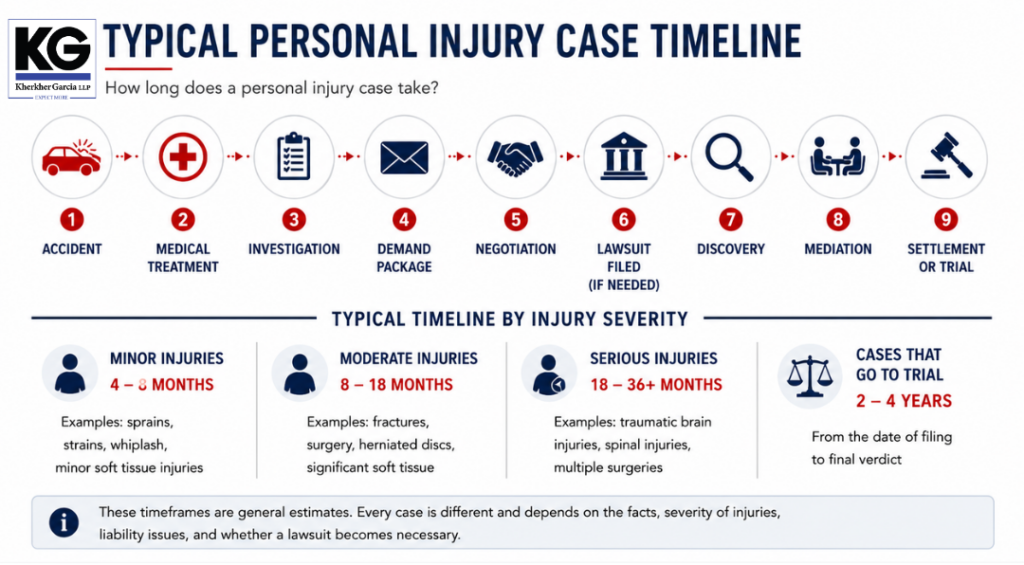
While every claim is unique, most personal injury cases fall within these general timeframes:
These estimates are only general guidelines. Factors such as the severity of your injuries, the complexity of your case, the number of parties involved, and whether a lawsuit becomes necessary can all affect how long your case ultimately takes.
Many people assume that once an accident occurs, the insurance company simply writes a check. Unfortunately, the process is almost never that straightforward. Every accident case involves its own unique combination of facts, evidence, and legal questions. Before a fair settlement can be reached, several important questions need to be answered, including:
The answers to these questions help determine the value of your case and how long it may take to resolve.
If you’ve been injured, your health should always be your top priority. One of the biggest mistakes accident victims make is rushing to settle their claim before they fully understand the extent of their injuries. Many serious injuries take months to diagnose, treat, and evaluate. In some cases, surgery or extensive rehabilitation may be necessary before physicians can determine the long-term effects.
Personal injury attorneys often refer to Maximum Medical Improvement (MMI). MMI doesn’t necessarily mean you’ve fully recovered. Rather, it means that your condition has stabilized enough that doctors can reasonably predict your future medical needs, ongoing limitations, and long-term prognosis. Reaching MMI is important because it helps establish:
Settling before reaching MMI may result in accepting compensation that doesn’t align with the full impact of your injuries. For this reason, skilled personal injury attorneys generally recommend allowing your medical treatment to progress before evaluating settlement options.
While you’re focusing on your recovery, your legal team is busy building your case. Building a strong personal injury claim requires much more than collecting medical bills or insurance statements. Depending on the circumstances, your attorney may investigate factors including:
The stronger the evidence, the stronger your negotiating position becomes. In more complex cases, additional investigation may be necessary before settlement discussions begin.
Once your injuries have stabilized and your damages can be reasonably calculated, your attorney typically prepares what’s known as a demand package. This package summarizes:
The insurance company reviews this information before deciding whether to negotiate a settlement.
Many clients expect the insurance company to immediately offer fair compensation. Unfortunately, that’s rarely how the process works. Insurance companies and adjusters often look to their own best interests before yours. They often request much more information and evidence before negotiating. This process often involves:
Several rounds of negotiations may occur before the parties reach an agreement. Because every claim is unique, this stage may last anywhere from several weeks to several months.
Many insurance companies begin negotiations with an offer that is much lower than what an injured person may ultimately recover. That’s why it is so important not to accept the first offer that is made. The claim doesn’t necessarily lack merit, but it may not account for all the facts. Initial settlement offers may not fully account for:
Accepting an early settlement may seem appealing, especially when medical bills and lost wages are piling up, but doing so may prevent you from seeking additional compensation later if your condition worsens.
Evaluating whether a settlement is fair requires a careful understanding of both your current and future losses.
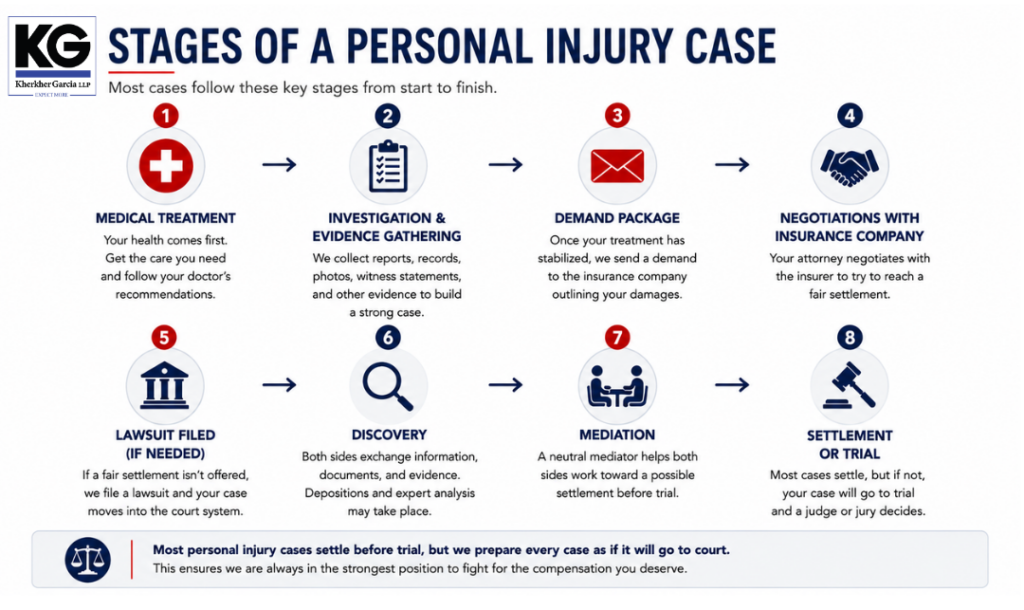
Not every personal injury claim resolves through settlement. If the insurance company disputes liability or refuses to offer fair compensation, your attorney may recommend filing a personal injury lawsuit. For most people, this sounds intimidating. But in reality, filing a lawsuit is simply the next step in the legal process. It is not necessarily an indication that your case will end up in a courtroom in front of a jury. In fact, many lawsuits are resolved through continued negotiations, mediation, or other forms of alternative dispute resolution before trial ever begins.
If negotiations reach a standstill, filing a lawsuit may be the next logical step. Many clients assume that filing a lawsuit means they will inevitably end up in court. Fortunately, that’s not usually the case.
Filing a lawsuit simply gives both sides access to the formal legal process. It allows attorneys to gather additional evidence, question witnesses under oath, request documents from the opposing party, and continue settlement discussions with a clearer understanding of the strengths and weaknesses of the case.
In many instances, filing a lawsuit actually encourages productive negotiations because both sides now have a better picture of the evidence and the potential risks of taking the case to trial.
Once a lawsuit is filed, the parties enter a phase known as discovery. Discovery can be the longest stage of a personal injury lawsuit, but it is one of the most important. During discovery, each side exchanges information about the accident and injury. That may include:
Attorneys may also conduct depositions, where witnesses and parties answer questions under oath. For more complex cases – such as trucking accidents, defective products, or industrial explosions – experts may be retained to analyze technical issues and provide opinions regarding liability or damages.
Although discovery requires time and patience, it helps clarify disputed facts and creates better opportunities for settlement before trial.
Before a case proceeds to trial, courts may encourage or order the parties to participate in mediation. Mediation is an informal, confidential conference led by a neutral third party known as a mediator. Unlike a judge or jury, the mediator does not decide who “wins.” Instead, they work with both sides to explore potential settlement options that are agreeable to both parties.
Many personal injury cases are resolved during mediation because both parties have had an opportunity to evaluate the evidence and understand the full extent of the injury and impact. Even if mediation does not immediately result in an agreement, it often narrows the issues and lays the groundwork for future negotiations.
Although trials receive the most attention in television dramas and news stories, the reality is that most personal injury cases settle before trial is necessary. Some cases do require a trial, such as when the parties cannot agree on liability or the amount of compensation.
At trial, each side presents evidence, examines (interviews) witnesses, and makes legal arguments before a judge and/or jury. Depending on the complexity of the case, a trial may last anywhere from a few days to several weeks. More complex cases can last months. If a verdict is reached, either party may have the right to appeal, which can further extend the timeline.
While trials generally require more time than settlements, they may be necessary when an insurance company or other party refuses to fairly compensate the victim.
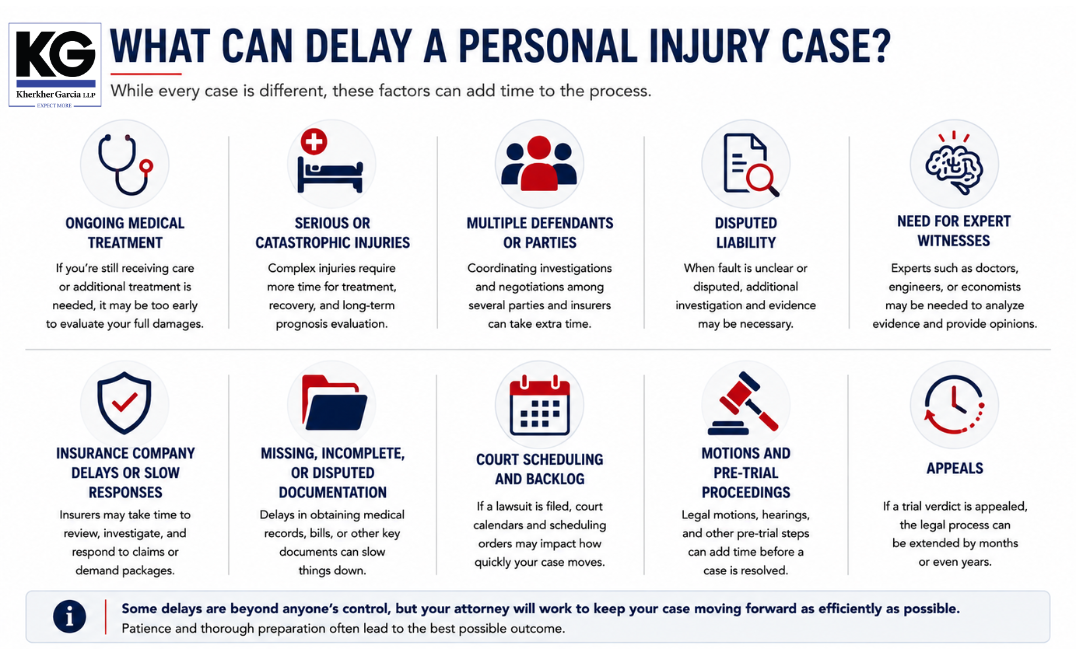
No one wants their case to take longer than necessary. However, certain circumstances naturally require additional time to ensure the claim is fully evaluated. Some of the most common factors that may extend the timeline include:
If you are still recovering, or additional procedures are anticipated, it may be too early to accurately calculate your future medical needs or long-term damages.
Life-changing injuries often require extensive treatment, rehabilitation, and expert evaluation before the full impact of the injuries can be understood.
Commercial truck accidents, construction accidents, and product liability claims often involve several potentially responsible parties. Coordinating investigations and negotiations among multiple parties can add time to the process.
If the parties disagree about who caused the accident, or whether multiple parties share responsibility, additional investigation may be necessary.
Medical experts, accident reconstruction specialists, engineers, economists, and vocational experts may all play important roles in personal injury cases.
If a lawsuit is filed, court calendars and scheduling orders may influence when hearings, mediation, and trial dates become available. Every court operates on their own schedule (docket), so it is important to note that a court with a higher volume may take longer to set cases for trial.
While some factors are beyond anyone’s control, there are several things injured individuals can do to help their case progress as efficiently as possible. Our recommendations include:
Consistent medical treatment creates a clear record of your injuries and demonstrates your commitment to recovery.
Save medical bills, receipts, prescriptions, photographs, and any correspondence related to your accident, injuries, work, or recovery.
Accurately communicating your limitations helps your medical providers and legal team understand the full extent of your injuries.
Responding promptly to requests for information can help avoid unnecessary delays.
Insurance companies sometimes review publicly available social media content when evaluating claims. Even seemingly harmless posts may be taken out of context and used to minimize your claim.
This is one of the main questions that many victims ask. The answer depends on the facts of your case. An early settlement offer isn’t necessarily unreasonable, but it’s important to remember that insurance companies often evaluate claims before the full extent of an injury is known.
If additional surgery, ongoing rehabilitation, or permanent limitations are still being evaluated, settling too soon could mean accepting compensation that doesn’t fully reflect your needs – now or in the future. A personal injury settlement should consider more than short-term expenses or losses. Depending on the circumstances, it may also include:
Because every case is different, it’s important to carefully evaluate any settlement offer before making a final decision.
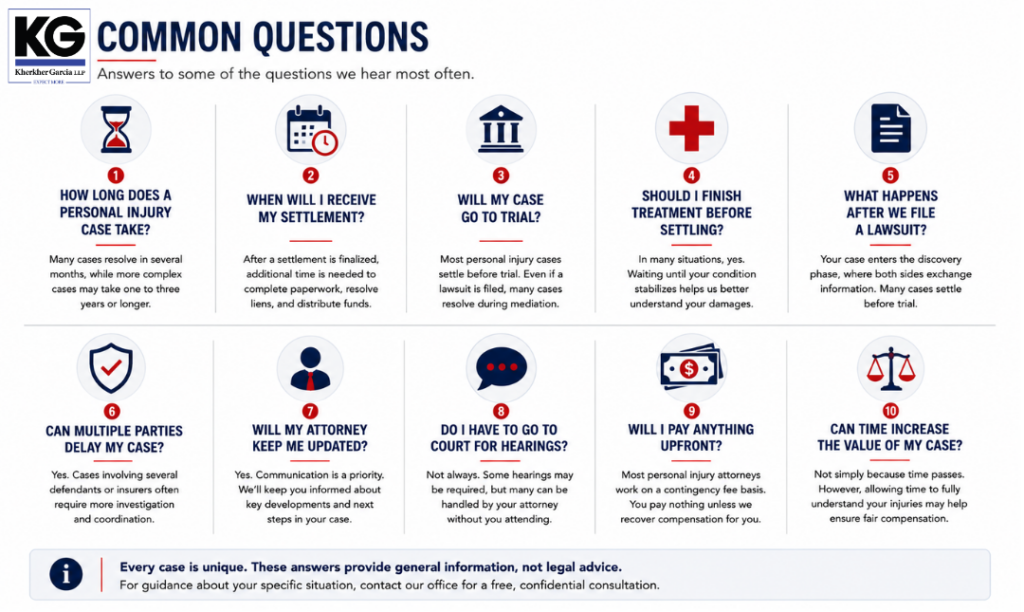
Ongoing medical treatment, serious injuries, multiple defendants, expert witnesses, and court scheduling are all common reasons why a case may take longer to resolve.
Possibly. Waiting until your condition stabilizes provides a clearer understanding of your damages.
Not necessarily. Many lawsuits settle during discovery or mediation before reaching a courtroom.
After a settlement is finalized, additional time is often needed to complete settlement paperwork, resolve medical liens if applicable, and process the distribution of funds. The exact timing varies depending on the circumstances.
Yes. Surgical procedures often require additional recovery time and follow-up care before doctors can accurately evaluate long-term prognosis and impact.
Yes. Cases involving several potentially responsible parties often require additional investigation and coordination between insurers, attorneys, and experts.
Communication is an important part of the attorney-client relationship. While every case progresses at its own pace, you should understand what stage your case is in and what to expect next.
No. While every case is different, many personal injury claims are resolved through negotiated settlements or mediation before a trial becomes necessary.
Not simply because time passes. However, allowing sufficient time to understand the full extent of your injuries and future medical needs may help ensure your damages are more accurately evaluated.
Recovering from an accident is stressful enough without wondering what comes next. While no attorney can guarantee exactly how long a personal injury case will take, understanding the legal process can help reduce uncertainty and allow you to make informed decisions every step of the way.
At Kherkher Garcia, we believe every client deserves honest answers, clear communication, and experienced legal representation. Whether your case involves a car accident, commercial truck collision, workplace injury, defective product, or another serious act of negligence, our team is committed to building a case that results in the best outcome possible.
If you have questions about your injuries or would like to discuss your legal options, contact Kherkher Garcia today for a free personal injury consultation. We will review your situation, explain what to expect, and help you understand the path forward. Call us at , or submit our online contact form to get started.

This page has been written, edited, and reviewed by a team of legal writers following our comprehensive editorial guidelines. This page was approved by attorneys Steve Kherkher and Jesus Garcia Jr., who have more than 50 years of combined legal experience championing the rights of those who have experienced catastrophic injury due to negligence.
Connect with a Kherkher Garcia trial lawyer today to pursue maximum compensation for your injury.